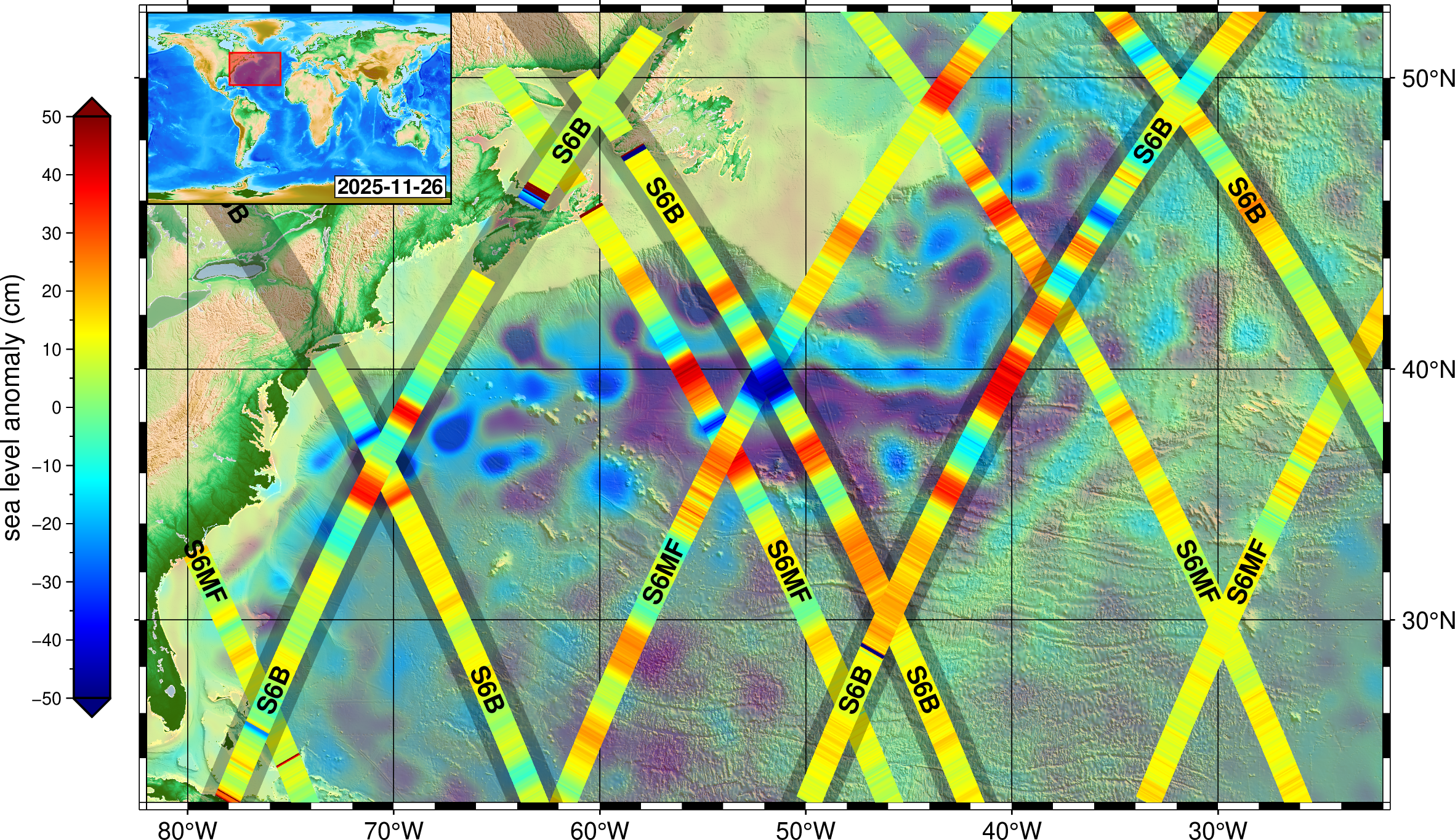
Sentinel-6B, a joint mission of U.S. and European partners, has started sending back its first measurements since launching in November.
This newly published map of the data shows sea levels across a vast stretch of the U.S. Eastern Seaboard and Atlantic Ocean. Within the crisscrossing bands, red indicates higher water relative to the long-term average; blue indicates lower water. The tracks are layered atop the combined observations of other sea-level satellites.
Roughly the size of a pickup truck, Sentinel-6B uses advanced radar altimetry to survey 90% of the world’s oceans and measure ocean height down to fractions of an inch. It works alongside its twin satellite, Sentinel-6 Michael Freilich, which launched in 2020, and continues a long-running record of global sea-level change. The mission’s full, calibrated data stream is expected next year.
Beyond sea level, the satellite also collects information on wind, waves, atmospheric temperature, and humidity, supporting everything from weather forecasting to climate monitoring.
The mission is a joint effort led by:
- NASA (National Aeronautics and Space Administration),
- ESA (European Space Agency),
- EUMETSAT (the European Organisation for the Exploitation of Meteorological Satellites), and
- NOAA (the National Oceanic and Atmospheric Administration).
Learn more: