5th Anniversary Highlight: Five Questions About the Founding of EOTEC DevNet
Five years ago, leaders across the Earth observation community confronted a critical challenge:
How could organizations working on sustainable development, disaster risk reduction, climate resilience, and other global challenges collaborate more effectively and make greater use of Earth observations in decision-making?
The challenge wasn’t a lack of satellite data, tools, or capacity-building resources. It was that they were spread across dozens of organizations. And international agencies tended to work in parallel, sometimes duplicating efforts, while national, regional, and local decision-makers missed out on valuable expertise, training, and connections.
These leaders made a key decision: to not create another organization, but rather to build stronger connections between the ones that already existed.
That idea became EOTEC DevNet: the Earth Observation Education, Training and Capacity Development Network.
As EOTEC celebrates its fifth anniversary, here is the story of how it began.
1. What problem was EOTEC DevNet created to solve?
The founders recognized that many international organizations were working toward sustainable development, climate resilience, and disaster risk reduction – but without collaborating closely.
Space agencies, meteorological agencies, development organizations, research institutions, and other partners had invaluable expertise, yet there was no simple way to connect their efforts, share experiences, or help national, regional, and local users navigate the rapidly expanding Earth observation ecosystem.
EOTEC DevNet was created to strengthen those connections.
2. Why not simply create another Earth observation program?
The world didn’t need another standalone initiative – it needed a way to connect the many organizations already invested in Earth observation education, training, and capacity development.
EOTEC DevNet was designed as a network of networks, building on existing international and regional organizations, rather than competing with them. Those international organizations – many of which had established regional networks – became the foundation for expanding collaboration, sharing expertise, and reaching new communities.
3. Who came together to make it happen?
EOTEC DevNet emerged from the shared vision of several agencies and organizations committed to expanding the use of Earth observations in decision-making.
Through the CEOS Working Group on Capacity Building and Data Democracy (WGCapD), and with leadership from organizations including NASA, ISRO, ESA, GEO, UNOOSA, WMO Education and Training Programme and WMO-CGMS VLab, and others, the founders sought to leverage the capabilities of all agencies together. Priority was placed on increasing coordination, reducing duplication, and maximizing human and financial resources.
They recognized that success depended on partnership.
4. Has the need for EOTEC DevNet changed over the past five years?
Yes and no. No, the original challenge has only become more important as countries and communities struggle with pressing environmental and socioeconomic challenges.
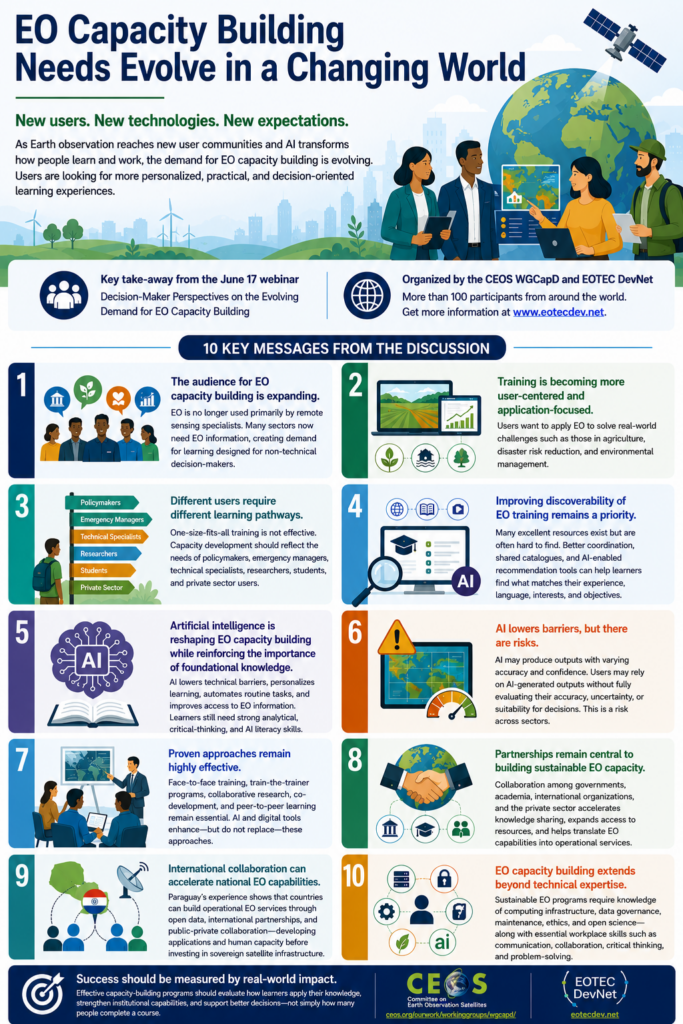
Yes, in that the demand for Earth observations is expanding far beyond the traditional remote sensing community. Governments at all levels, businesses, humanitarian organizations, and others increasingly rely on Earth information to inform their decisions – and all of them have specific needs for education, training, and capacity.
Adding to that, artificial intelligence, cloud computing, and other technologies are making Earth observations more accessible to more people – and introducing new challenges.
The opportunity today centers on close collaboration and dedicated efforts to help the growing community of users navigate resources that will help them address their challenges.
5. Please tell me, where does EOTEC’s long name come from?
The founders wanted the network to reflect the many ways organizations describe their work. Some focus on education; others on training, capacity development, or workforce development.
Rather than choosing one term, they deliberately included Education, Training, and Capacity Development in the name to make the network as widely engaging as possible.
That philosophy continues today. Through regional communities of practice, thematic working groups, partnerships, collaborative resources, and knowledge sharing, EOTEC DevNet continues to connect people, organizations, and ideas, helping ensure that Earth observations become an increasingly valuable part of decision-making around the world.
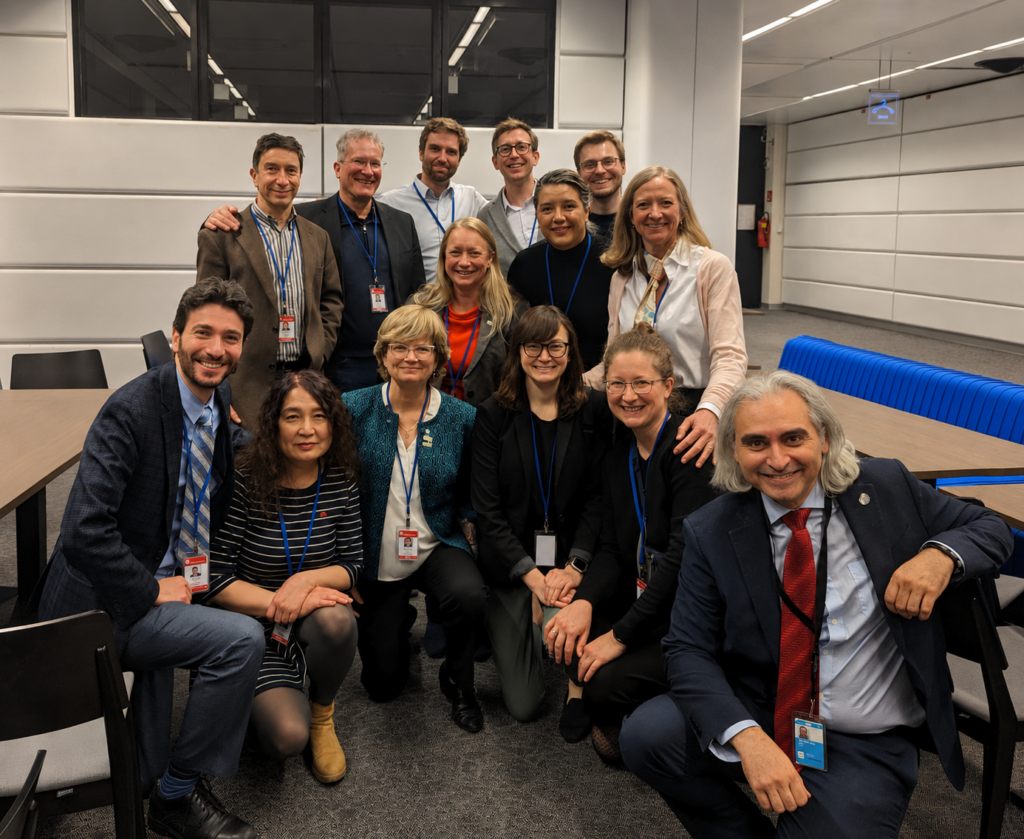
Image: Several of EOTEC DevNet’s global and regional task team leads and Secretariat staff came together in 2024 for an annual leadership meeting to explore impact and future priorities.