Insights on Anticipatory Action for Drought

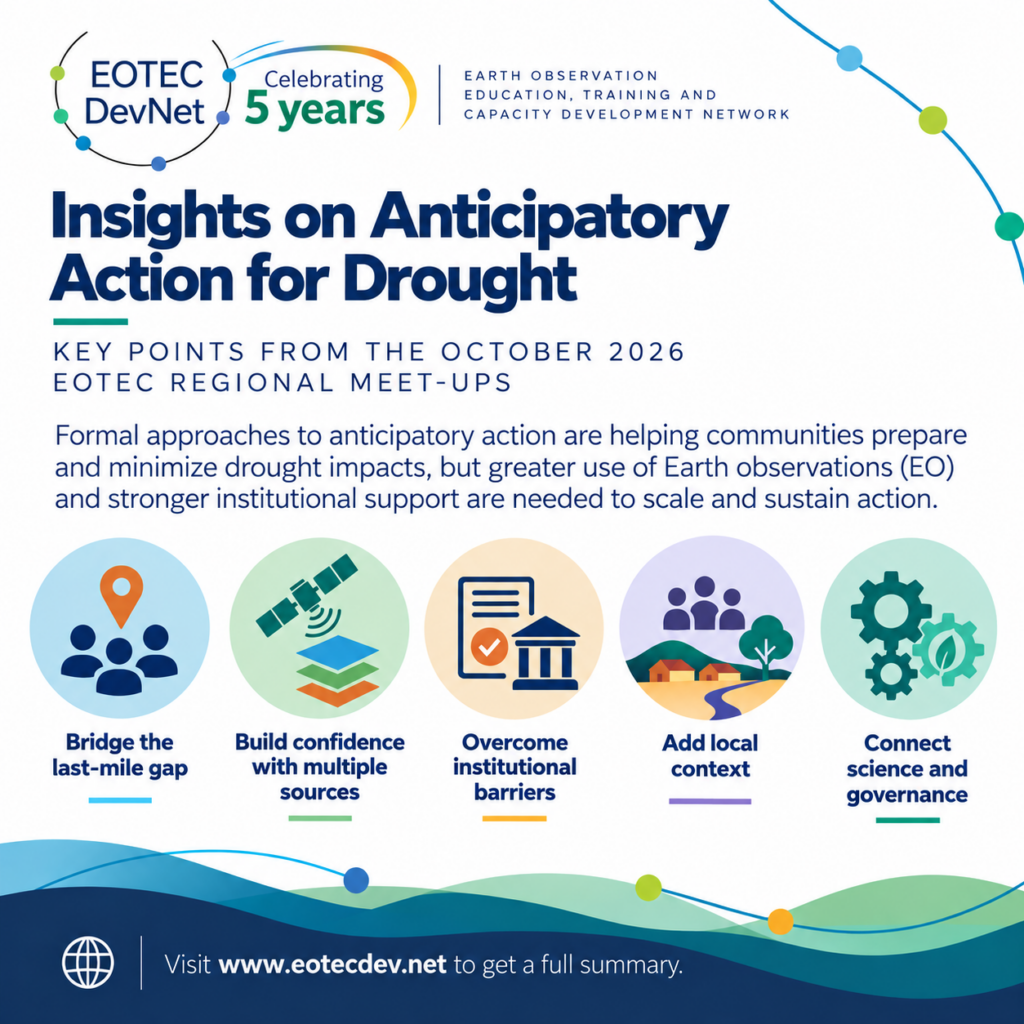
Key Points from the October 2026 EOTEC Regional Meet-ups
Formal approaches to anticipatory action are helping communities prepare for and minimize drought impacts but expanded use of Earth observations (EO) remains critical to improving disaster response. Key to success is strengthening institutions and building decisionmakers’ confidence and capacity to apply EO.
This was the high-level, cross-cutting takeaway of EOTEC DevNet’s recent regional Drought Working Group meet-ups, which convened practitioners across Africa, the Americas, Asia-Oceania, and Europe around the theme: Closing the Gap on Anticipatory Action for Drought.
The October 14/15 virtual meet-ups brought together Earth observation (EO) experts, humanitarian practitioners, and climate researchers to explore how satellite data, predictive modeling, and pre-agreed triggers are enabling earlier, more effective disaster risk management.
The range of insightful presentations highlighted:
- Forecast-based financing and early action protocols in Africa (Ethiopia, Lesotho, Zambia, Zimbabwe) and Central and South America (Colombia, El Salvador, Guatemala)
- Anticipatory action experience in fragile settings and conflict zones
- How a convergence of evidence approach to multiple data sources is a tool for early action
- Lessons learned on how the existence of national-level drought forecasting systems in Europe affected preparedness
Get more detail: scroll down for the list of presenters, slides and short video recordings of the presentations.
Other Cross-region Insights
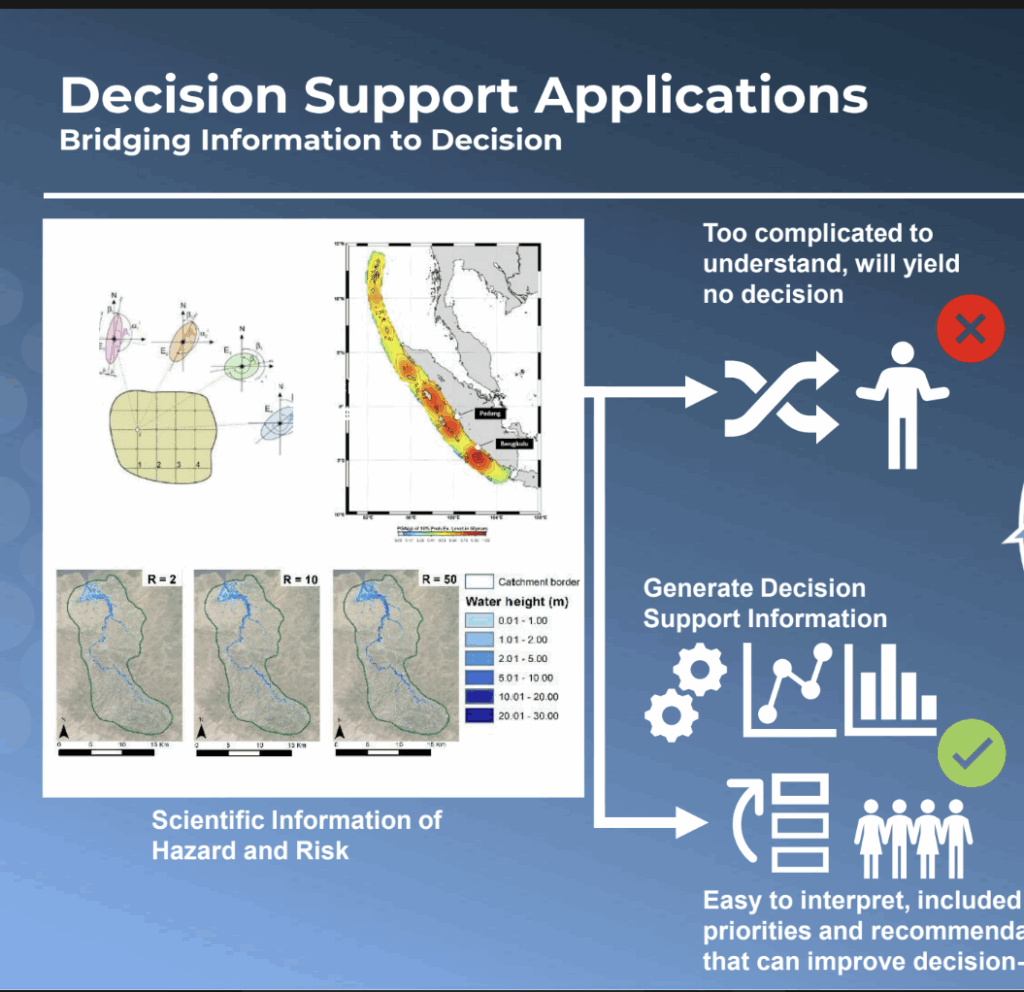
- Bridging the Last-Mile Gap: Better forecasts do not automatically lead to action. Early warning information must reach local decision makers, pastoralists, and farmers in a timely, understandable and usable form – and be linked to coordinated and financed action.
- Building Confidence Through Multiple Sources: Early action is more likely when analysis draws on multiple data sources. For drought, combining precipitation, evapotranspiration, soil moisture, vegetation, and ground observations can reduce false alarms and build decisionmakers’ confidence in EO-based triggers.
- Overcoming Institutional Barriers: Decisionmakers may be reluctant to take action before established, “official” processes – such as formal declarations of drought – unfold. Embedding triggers in national frameworks and continuously demonstrating their reliability can foster institutional and political confidence.
- Adding Local Context: In fragile and conflict-affected settings, hazard data alone are not enough. EO needs to be combined with information on land tenure, population movement, and social dynamics to guide effective action and avoid exacerbating conflict.
- Connecting Science and Governance: Bringing together hydrological science, social science, and policy can improve drought response, while stronger coordination across administrative boundaries can help address fragmented drought management.
Update on EOTEC’s Drought Tools Tracker
EOTEC DevNet’s Drought Tools Tracker is undergoing its validation phase and is targeted for launch in early 2027. The tool, which will help users navigate EO drought products, now features:
- 50+ key drought monitoring tools and datasets
- 70+ training and capacity-building resources
What’s Next for EOTEC?
- Global Webinar: Communicating the Value of EO to Decision Makers – November 24, 2026
- Regional Flood Working Group Meet-ups – January 20/21, 2027
- Task Team Meeting – March 17/18, 2027
- Regional Drought Working Group Meet-ups – April 14/15, 2027
Presenters, slides and video recordings
- Africa:
- Dr. Emmanuel Poan (Red Cross Red Crescent Climate Centre) detailed the use of Forecast-based Financing and Early Action Protocols in Zimbabwe, Ethiopia, Lesotho, and Zambia
- Dr. Abebe Kebede (Arba Minch University / Ethiopian Institute of Agricultural Research) presented on drought monitoring and forecast-informed anticipatory action in East Africa
- [Meeting slides]
- Americas:
- Dr. Juan Bazo (Red Cross Red Crescent Climate Centre) presented operational anticipatory action frameworks in El Salvador, Guatemala, and Colombia.
- Dr. Gabriel Senay (USGS Earth Resources Observation and Science Center) outlined FEWS NET’s convergence-of-evidence approach to drought early warning
- [Meeting slides]
- Asia-Oceania:
- Dr. Muhammad Khalifa (International Water Management Institute – IWMI) discussed advancing anticipatory action in Fragile and Conflict-Affected Settings, emphasizing “decision intelligence” platforms that combine hydro-climatic EO data with socioeconomic vulnerability, population displacement, and conflict dynamics.
- Dr. Shahzada Adnan (Pakistan Meteorological Department) shared practical insights into Pakistan’s anticipatory action approaches.
- [Meeting slides]
- Europe:
- Dr. Riccardo Biella (UFZ Helmholtz Centre for Environmental Research) and Dr. Anastasiya Shyrokaya (KTH Royal Institute of Technology) shared findings from a 30-country survey of 481 European water managers, which found that governments with formal drought forecasting systems responded faster than those without.
- [Meeting slides]
Thanks for reading!