Recap & Resources: Flash Flood Monitoring and Early Warning Systems

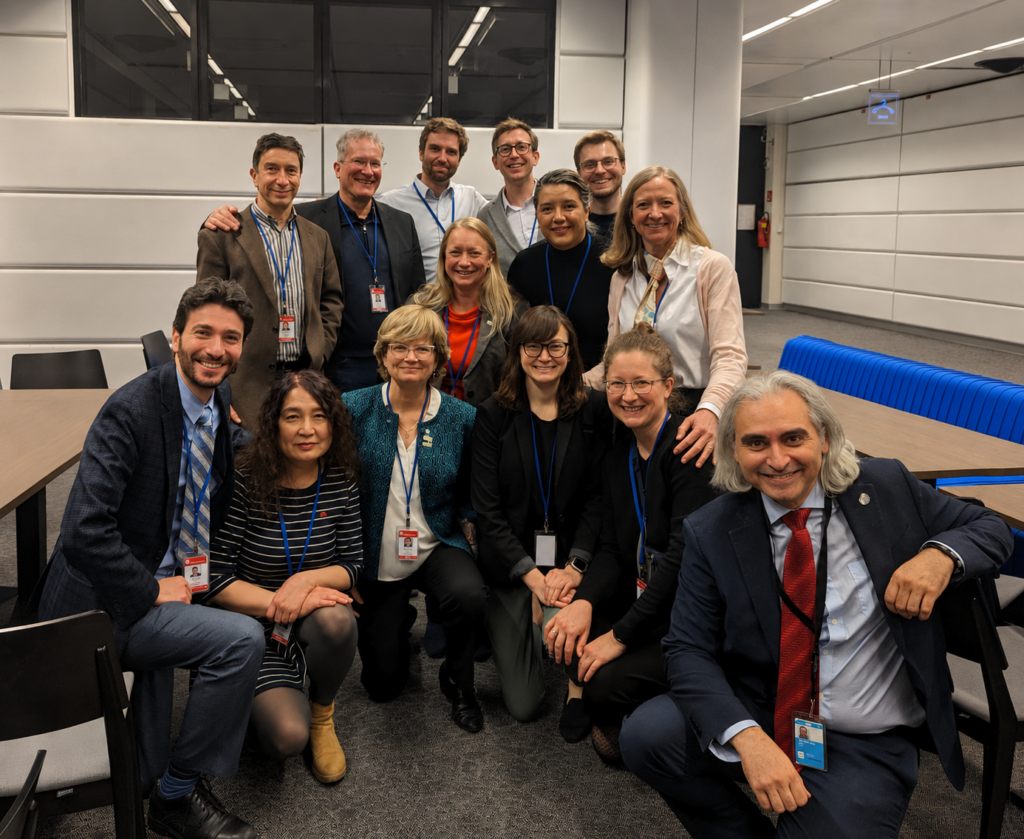
Thank you to everyone who joined the EOTEC DevNet Regional Flood Working Group meet-ups on 8–9 July 2026. The sessions brought together participants from around the world to discuss one of today’s most pressing challenges in disaster risk management: monitoring and forecasting flash floods using Earth observation, hydrological modelling, and operational early warning systems.
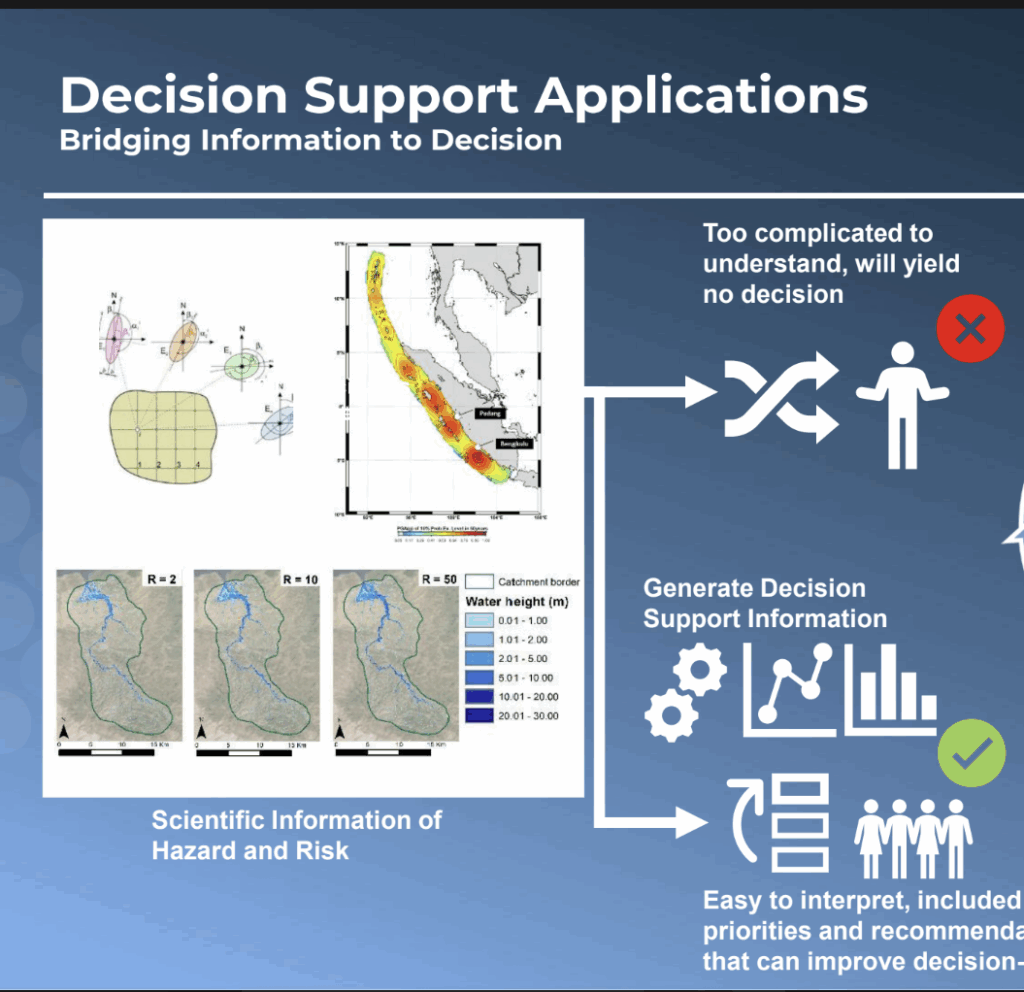
Across the four regional sessions, experts showcased global and regional approaches to flash flood forecasting, risk assessment, exposure mapping, and decision support. The discussions highlighted shared challenges and practical lessons for turning scientific information into actionable warnings.
Key Takeaways from the Presentations
Global spotlight
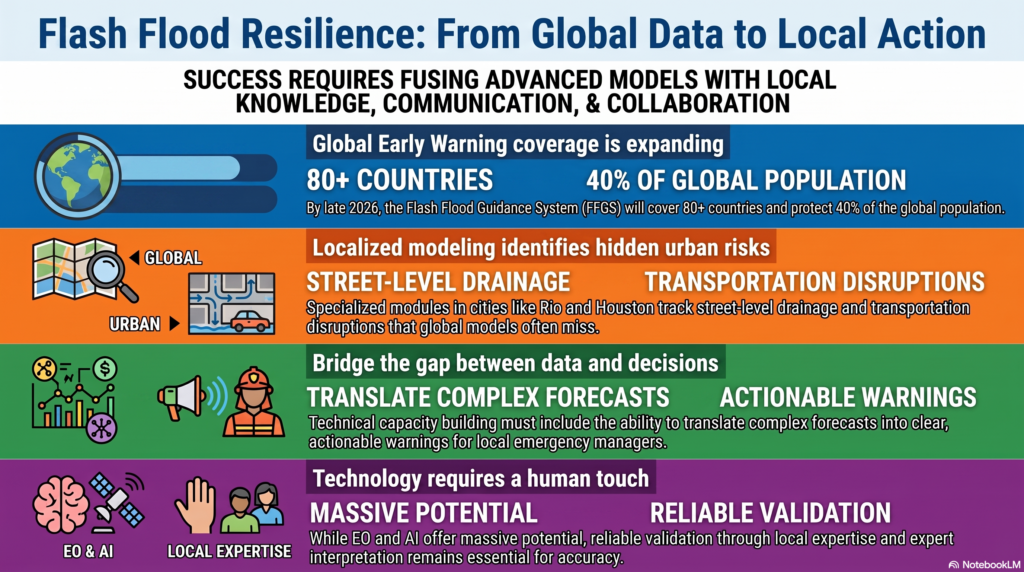
Eylon Shamir from the Hydrologic Research Center presented the Flash Flood Guidance System (FFGS), showing how satellite observations, forecasts, hydrological modelling, and local expertise can be combined to support operational early warning. A central message was that such systems are designed to strengthen the work of national forecasters rather than replace them. By the end of 2026, FFGS is expected to cover more than 80 countries through 16 regional and national systems, providing early warnings for more than 40% of the global population.
Africa region spotlights
Jean Danumah presented a case study from Grand-Bassam, Côte d’Ivoire, showing how Google Earth Engine and Earth observation data can support flood susceptibility mapping and exposure analysis. The presentation highlighted how a multi-criteria optimization approach can balance risk factors such as slope, land use, and rainfall to identify vulnerability patterns.
A second regional contribution by Dr. Ndidi Felix Nkeki focused on changing flood regimes in the Lower Niger–Benue Basin. The study highlighted the importance of locally tailored flood planning and mitigation, especially in contexts where hydrological conditions are changing over time.
Americas region spotlights
Augusto Getirana presented an urban flood monitoring system developed for Rio de Janeiro in partnership with NASA. The model includes a dedicated urban drainage module, as Rio’s floods are primarily caused by storms combined with poor drainage rather than river overflow. The system simulates different drainage scenarios to help the municipality prioritize infrastructure improvements.
Avantika Gori shared work on hurricane-related flood risk in Texas, covering both data-rich urban areas and data-sparse rural communities. Her research examines compound flooding, analysing how extreme winds, storm surges, and heavy rainfall interact to increase flood impacts. It also maps how long neighbourhoods may be cut off from critical facilities, such as fire stations, to support emergency planning and resource mobilization.
Together, the Americas presentations showed how EO, modelling, and local partnerships can support emergency management, infrastructure planning, and long-term resilience.
Asia–Oceania region spotlight
The Asia–Oceania session focused on the Flash Flood Guidance System and included an interactive discussion on model performance, data limitations, operational use, and the role of local expertise in interpreting warnings.
Europe region spotlight
Calum Baugh from the European Centre for Medium-Range Weather Forecasts (ECMWF) presented flash flood forecasting within the European Flood Awareness System (EFAS). He explained how EFAS supports pan-European flash flood awareness through short-range forecasts, probabilistic information, and products designed to support national and regional forecasting services. The discussion stressed the need to adapt products to different users, communicate uncertainty clearly, and combine regional information with national and local knowledge.
Lessons from the Discussions
Across the four sessions, several common messages emerged:
- EO products are most effective when combined with local knowledge and operational experience.
- Early warning depends not only on technology, but also on communication and collaboration between forecasters, disaster managers, and other stakeholders.
- Decision-makers need clear information on uncertainty, limitations, and the appropriate scale of forecasts.
- Capacity building should support both technical skills and the ability to translate forecasts into actionable warnings.
- While AI offers significant potential, reliable data validation and expert interpretation remain essential.
Participant Feedback
The short polls during the meetings reinforced these conclusions. Participants most frequently highlighted the importance of:
- integrating EO and hydrometeorological data;
- improving communication with end users;
- strengthening local-scale modelling;
- validating products and models;
- ensuring timely access to data.
Capacity development priorities included stronger national modelling skills, better integration of EO into forecasting workflows, and improved access to high-resolution, near-real-time information.
Recordings and Slides
The general slide decks for each regional session will be updated as speaker presentations become available.
All available recordings and presentation slides are linked below:
General slide decks
Africa session deck
Americas session deck
Asia–Oceania session deck
Europe session deck
Speaker recordings
Flash Flood Guidance presentation
Grand-Bassam presentation
Lower Niger–Benue presentation
Rio de Janeiro presentation
Texas hurricane flood risk presentation
EFAS presentation
Future Topics
Participants expressed interest in continuing the exchange on:
- urban and flash flood forecasting;
- impact-based forecasting;
- EO and hydrological model integration;
- product validation;
- AI applications;
- communication of uncertainty.
If you have ideas for future topics or would like to contribute a presentation at an upcoming Flood Working Group meeting, please contact us at secretariat@eotecdev.net.
Thank you once again to all speakers, regional leads, and participants for sharing your expertise and experiences.
We look forward to continuing the discussion at the next EOTEC DevNet Flood Working Group meetings in January 2027.