EO Training in 2026: Insights from 4 Regions, 15 Providers

In March 2026, the EOTEC DevNet community came together across Africa, the Americas, Asia-Oceania, and Europe for Community of Practice (CoP) meet-ups to review 2026 training plans.
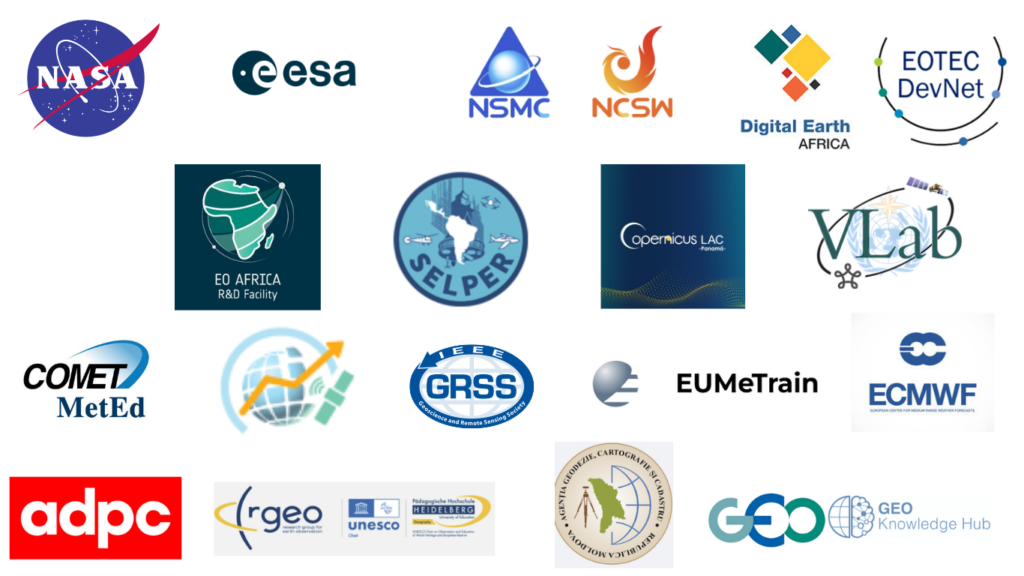
More than 110 Earth observation (EO) practitioners and stakeholders joined the discussions and heard from global and regional training providers on planned training and opportunities for collaboration in the year ahead. A sincere thanks to the 15+ providers who presented at the four meet-ups.
Find links to recordings and presentations below.
A clear picture emerged: the global EO training landscape is vibrant and evolving rapidly in response to new technologies and user needs. But continued cooperation is required to help potential trainees connect to training opportunities.
A Growing Training Ecosystem
Participants highlighted a wide range of existing training initiatives, from global platforms to specialized regional efforts and thematic technical trainings. Despite this variety and depth, discoverability remains a key challenge.
To help address this challenge, EOTEC DevNet demonstrated a new web-based tool: Places to Find Training. This tool aggregates nearly 40 websites and platforms hosting online and recorded short courses, webinars, and other capacity building resources. Its intent is to close the gap between what potential training participants need and what the vast array of providers offer.
Demand Remains Steady
In the discussions, participants noted that foundational EO training is widely available, but there is growing need for:
- Advanced, application-oriented training
- Operational use cases tied to real-world decisions
- Integration of emerging technologies — especially AI
Topics in highest demand include:
- AI and machine learning for EO and GIS workflows
- Flood forecasting, disaster response, and hazard monitoring
- Agricultural applications such as crop monitoring and yield estimation
- Hydrology and drought monitoring
- InSAR and integration of drone and satellite data
- Reproducible workflows and data pipelines
There is also a clear need to reach decision-makers, public authorities, and operational service providers — not just technical specialists.
What Makes Training Effective?
Participants shared practical insights on how to design and deliver more effective training:
- Short, modular formats work better for busy professionals
- Certificates and incentives can improve completion rates
- Continuous feedback loops help align training with real needs
- Partnerships and conferences are key for engagement
- Targeted outreach and social media increase visibility
- Integration with thematic areas (e.g. disaster risk, water management) improves relevance
A key message: capacity building is not a one-off activity – it requires continuous interaction with users.
Persistent Challenges – and Opportunities
Several cross-cutting challenges emerged:
- Engagement remains difficult → high dropout rates highlight the need for flexible, hybrid learning formats
- Siloed approaches limit impact → coordination and visibility must improve
- Demand for applied training is growing → especially for operational use
- Localization matters → training must reflect regional contexts and reach underserved communities
- Scaling is essential → academic integration, partnerships, and platforms like Moodle can help expand reach
From Insights to Action
The discussions are already informing next steps for the EOTEC DevNet community.
You can get involved by:
- Exploring and contributing to the new “Places to Find Training” resource
- Sharing feedback on training needs and gaps
- Joining upcoming Community of Practice and Working Group activities
- Expressing interest in presenting at future Task Team meetings
📅 Upcoming: Regional Drought Working Groups
- Africa — April 22 (13:00–14:15 UTC)
- Americas — April 22 (16:00–17:15 UTC)
- Asia–Oceania — April 23 (04:00–05:15 UTC)
- Europe — April 23 (13:00–14:15 UTC)
Links to recordings and presentations
- ADPC – Susantha Jayasinghe
- AGCC (Moldova) – Constantin Osoianu
- COMET – Amy Stevermer
- Copernicus LAC – Itziar Alonso & Nicolas Ayala
- Digital Earth Africa – Kenneth Mubea
- ECMWF – Chris Stewart
- EO Africa R&D Facility – Arno van Lieshout
- ESA – Connor Heeney (Asia/Oceania)
- ESA – Connor Heeney (Europe)
- ESA – Magdalena Fitrzyk (Americas)
- ESA GDA – Christoph Aubrecht
- EUMETSAT / EUMeTrain – Dominik Rukavina
- GEO Knowledge Hub / AfriGEO – Letwin Pondo
- Heidelberg University of Education – Nils Schorndorf
- IEEE GRSS – Carlos López-Martínez
- ISRO / IIRS – CM Bhatt
- NASA ARSET – Brock Blevins
- NSMC – Jingyan Wu
- VLab Casablanca